
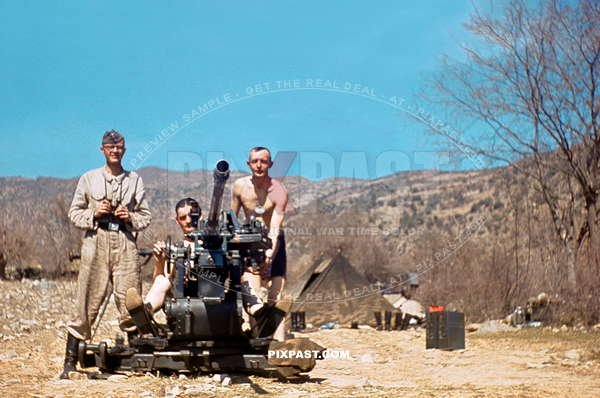
German 2 cm Flak 38 Anti-Aircraft Cannon with Crew, Greece June 1940
Digital Download Only: Upon purchase and successful payment, you will receive the selected image as a high-resolution JPG digital download. No physical photographs or printed copies are included in this transaction.
German 2 cm Flak 38 Anti-Aircraft Cannon with Crew, Greece June 1940
Description
This original 1940 Agfacolor slide photograph shows a German 2 cm Flak 38 anti-aircraft cannon positioned outdoors in a dry, mountainous landscape, identified as near Athens, Greece by the filename. Three German soldiers are present: one stands at left holding binoculars, another operates the Flak 38 seated, and a shirtless soldier stands behind the weapon. In the background are beige military tents and scattered equipment. The soldiers wear lightweight summer uniforms suited to the warm weather. The 2 cm Flak 38, a widely used Luftwaffe and Wehrmacht small-caliber anti-aircraft gun of the period, is shown in clear detail with its characteristic barrel and mounting. The setting suggests a forward deployment or a training position in mid-1940 during the early stage of German military operations in the Balkans. The filename's information aligns well with the visual evidence. The image is valuable for illustrating German air defense equipment and personnel in the Mediterranean theatre during World War II.
Dieses Original-Farbdia von 1940 in Agfacolor zeigt eine deutsche 2 cm Flak 38 Flugabwehrkanone, die im Freien in einer trockenen, bergigen Landschaft nahe Athen, Griechenland (laut Dateiname) aufgestellt ist. Drei deutsche Soldaten sind zu sehen: einer steht links mit einem Fernglas, ein zweiter bedient die Flak 38 im Sitzen, und ein dritter Soldat ohne Hemd steht hinter der Waffe. Im Hintergrund sind beige Militärzelte und verstreute Ausrüstung zu erkennen. Die Soldaten tragen leichte Sommeruniformen, die dem warmen Wetter angepasst sind. Die 2 cm Flak 38, eine häufig eingesetzte kleine Flugabwehrkanone der Luftwaffe und Wehrmacht, ist mit ihrem charakteristischen Lauf und ihrer Halterung gut erkennbar. Die Szene deutet auf eine Vorwärtsstellung oder eine Übungsposition im Sommer 1940 während der frühen Phase der deutschen Operationen auf dem Balkan hin. Die Angaben im Dateinamen stimmen gut mit den sichtbaren Details überein. Das Bild ist wertvoll zur Veranschaulichung der deutschen Luftabwehrtechnik und Mannschaften im Mittelmeerraum im Zweiten Weltkrieg.
Related products
-

WW2 color french Citroen car village shop street soldiers France 1940
Add to cart -
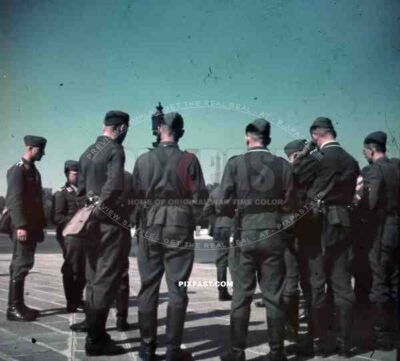
german soldiers officers tourist visit Paris France 1940 flak luftwaffe airforce unit.
Add to cart -
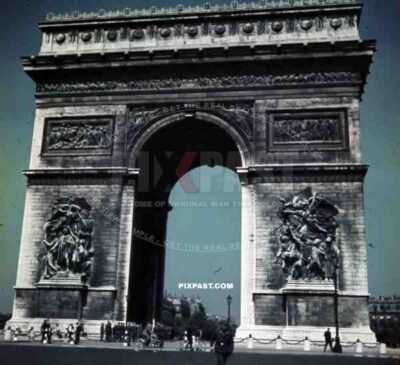
Arc de Triomphe paris france 1940 german occupation soldiers wehrmacht military
Add to cart -
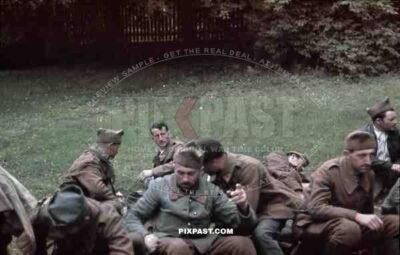
French army POW soldiers taken near Verdun France by the German Wehrmacht. Fall of France 1940
Add to cart
Reviews
There are no reviews yet.