
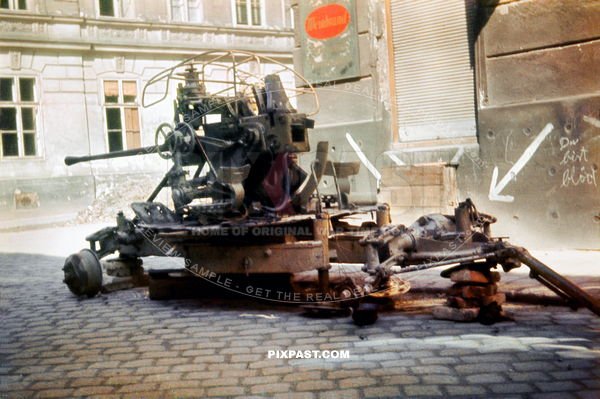
Russian 45mm Anti-Tank Gun PaK 38 in Vienna, 1945
Digital Download Only: Upon purchase and successful payment, you will receive the selected image as a high-resolution JPG digital download. No physical photographs or printed copies are included in this transaction.
Russian 45mm Anti-Tank Gun PaK 38 in Vienna, 1945
Description
This color photograph shows a Russian 45mm PaK 38 anti-tank gun positioned on a cobblestone street in an urban area. The photo, purportedly taken in Vienna in 1945, depicts the artillery piece with its carriage stabilized on makeshift stone supports. Surrounding architecture indicates a European city setting with plastered building facades and shuttered windows. The gun's characteristic thin barrel and the protective wireframe shield for the gunner are discernible, supporting identification of the weapon as the Soviet 45mm PaK 38 or a very similar model. There is some graffiti on the wall behind the gun, and the urban environment suggests wartime or immediate post-war streetscape damage or military presence in Vienna near the end of World War II. Archive context mentions Germany in 1940, but filename clues indicating Vienna 1945 and the visible artillery type align better with Soviet use in Austria in 1945. The attribution to Russia and Vienna is consistent with the red Army's presence in Austria during April-May 1945.
Dieses Farbfoto zeigt eine russische 45-mm-PaK 38-Panzerabwehrkanone, die auf einer Kopfsteinpflasterstraße in einem städtischen Gebiet positioniert ist. Das Foto, das angeblich 1945 in Wien aufgenommen wurde, zeigt das Geschütz mit seinem Lafettenträger, der auf provisorischen Steinunterlagen abgestützt ist. Die umgebende Architektur weist auf eine europäische Stadtkulisse mit verputzten Gebäudefassaden und verschlossenen Fenstern hin. Der charakteristisch dünne Lauf und der Schutz-Gitterrahmen für den Schützen sind erkennbar, was die Identifikation der Waffe als sowjetische 45-mm-PaK 38 oder ein sehr ähnliches Modell stützt. An der Wand hinter der Kanone sind Graffitis zu sehen, und das städtische Umfeld deutet auf Kriegsschäden oder die militärische Präsenz in Wien nahe dem Ende des Zweiten Weltkriegs hin. Der Archivkontext nennt Deutschland 1940, doch die Angaben im Dateinamen mit Wien 1945 und die sichtbare Artillerie entsprechen besser der sowjetischen Nutzung in Österreich 1945. Die Zuordnung zu Russland und Wien passt zur Roten Armee, die im April-Mai 1945 in Österreich präsent war.

Reviews
There are no reviews yet.